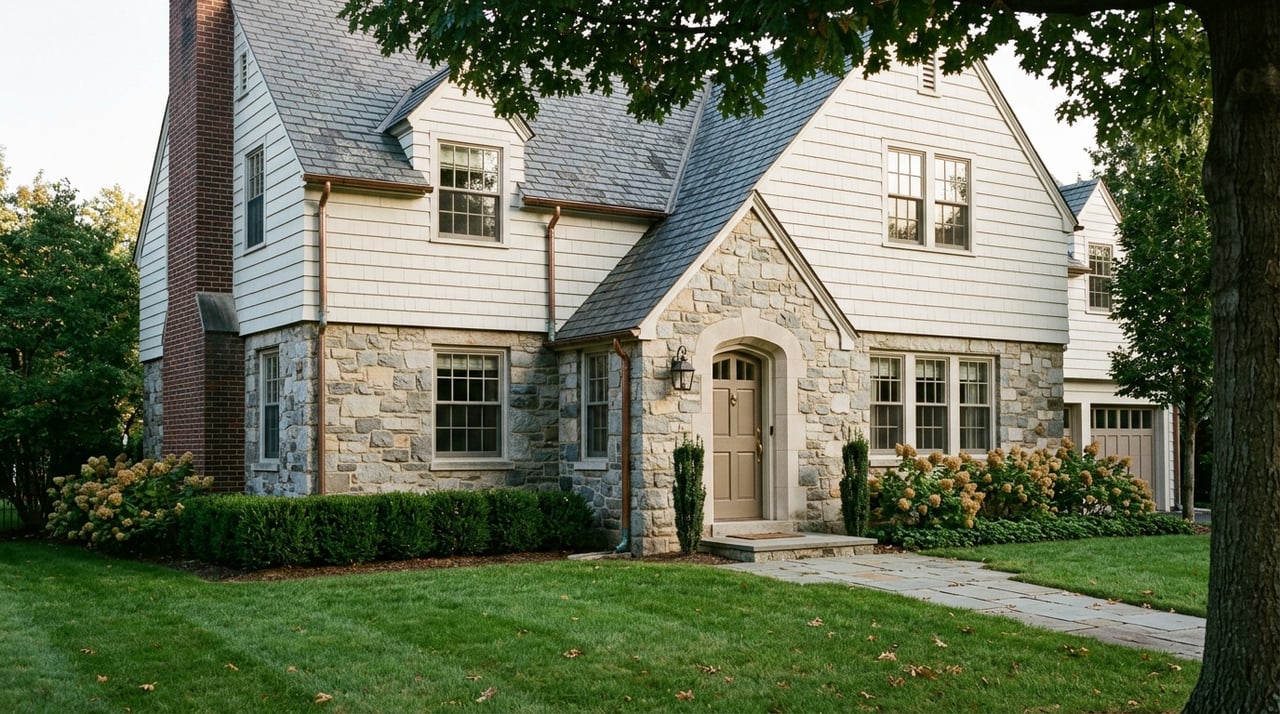
Guide To Historic Homes And Architecture In Bernardsville
June 25, 2026
June 25, 2026
If you are drawn to homes with character, Bernardsville gives you plenty to look at. From early neighborhood houses to landmark downtown buildings and estate-era properties in the hills, the borough’s architecture tells a long local story. If you are thinking about buying, selling, or simply understanding older homes here, this guide will help you spot key styles, understand what makes Bernardsville distinct, and know what to expect from historic housing. Let’s dive in.
Bernardsville’s architectural identity grew over time, not all at once. The area began as Vealtown, a settlement along Mine Brook first settled in 1736, was renamed Bernardsville in 1840, and changed again after railroad service arrived in 1873.
That history still shows up in the built environment today. According to the borough’s downtown walking tour, downtown Bernardsville remains close to the footprint it had about a century ago, with buildings from the 18th, 19th, and 20th centuries still part of the streetscape.
Another major influence came after the Civil War. Wealthy New Yorkers began building summer residences in the hills north of town, shaping the area known as the Mountain Colony and giving Bernardsville a lasting reputation for estate homes.
One of the most interesting things about Bernardsville is its variety. You do not see just one style repeated block after block. Instead, you see a mix of residential forms, civic landmarks, storefronts, and estate-era influences that reflect different chapters of the borough’s growth.
The borough’s downtown zoning guidebook describes a core with varied architecture. Some Main Street buildings are early 20th-century masonry and stucco shopfronts built close to the sidewalk, while others are older residential-style structures with shallow yards, porches, sloped roofs, and siding.
That mix gives Bernardsville a layered feel. It is one reason older homes and historic buildings here often appeal to buyers who want something more distinctive than newer, more uniform housing.
If you are touring homes in Bernardsville, especially in and around the Olcott Avenue area, a few architectural styles are especially worth knowing.
Colonial Revival homes are part of Bernardsville’s early 20th-century architectural story. In local examples, you may notice clapboard siding, symmetrical window placement, 6-over-6 sash windows, transoms, and porch details that feel formal but still welcoming.
The Olcott Historic District walking tour points to 6 Childsworth Avenue and 54 Olcott Avenue as useful examples. Features like boxed eaves, brackets, dentil detail, and shingled upper stories help show how this style could be both traditional and visually rich.
Craftsman and Foursquare-influenced homes often feel practical, grounded, and highly livable. In Bernardsville, these homes may include broad front porches, hipped roofs, overhanging eaves, dormers, and visible woodwork details.
A local example is 17 Olcott Avenue, which includes a hipped roof, exposed rafter tails, hipped dormers, a stucco bay window, and a broad front porch with squared openings. If you like homes with strong curb appeal and classic proportions, this style is worth a closer look.
Bernardsville also includes homes with more decorative and storybook-like details. Eclectic Revival and Tudor Revival influences can show up through steep rooflines, patterned windows, decorative trim, and varied materials.
The walking tour describes 41 Highview Avenue as an Eclectic Revival house with Swiss or German folk details. Overhanging eaves, decorative trim, and patterned casement windows help give this type of home a more distinctive personality.
For many buyers, the Olcott Avenue Historic District is the clearest place to see Bernardsville’s early residential character in one area. Somerset County and borough planning documents describe it as an early 20th-century, entirely residential middle-class neighborhood originally designed for merchants and entrepreneurs.
The district was listed on the National Register in 2009. It is known for its mix of late-19th- and early-20th-century styles, including Colonial Revival, Tudor Revival, Eclectic Revival, Craftsman, and Shingle.
A big reason the district feels cohesive is that much of the streetscape has remained intact. Early deed restrictions on lot size and use helped preserve the neighborhood’s overall pattern, which is still visible today.
Bernardsville’s historic architecture is not limited to houses. Downtown includes several notable buildings that help explain how the borough evolved over time.
The John Parker Tavern is a pre-Revolutionary-era crossroads tavern that later became the town library. The Old Stone Hotel, which opened in 1849, remains one of the few mid-19th-century structures in Bernardsville that still retains historic fabric, even though later additions were made.
Other standout buildings reflect a range of architectural influences. Bernardsville Station combines Colonial Revival and Romanesque elements, St. Bernard’s Church and Parish House is a Gothic Revival landmark, the Bernards Inn is a Mission-style stucco hotel, and the Bernardsville National Bank is a Neoclassical building.
Bernardsville’s preservation footprint is broader than many people realize. A 2025 Highlands Council report says 502.2 acres, or 6.1% of the borough, fall within five recognized historic districts.
Those districts are the Gladstone Branch of the DL&W Railroad Historic District, the Olcott Avenue Historic District, Morristown National Historical Park’s New Jersey Brigade Encampment, Hardscrabble Road, and Pleasant Valley, also known as O-Wan-O-Massie.
These districts are described as significant historic and cultural resources that help define Bernardsville’s identity. For buyers and sellers, that matters because historic context here is part of the borough’s broader planning and preservation landscape, not just a niche interest.
Historic character in Bernardsville is actively documented and valued. The borough’s Historic Advisory Committee says it was founded in 2002 and has identified more than 100 historic structures.
The committee also helped register the Olcott Avenue Historic District, supported the Dunster-Squibb property, and worked on a thematic nomination for the Somerset Hills Country Place Era from 1870 to 1940. Somerset County grant funding has also supported preservation work in Bernardsville.
That local effort helps explain why older properties here often feel like part of a larger story. For you as a buyer or seller, it is a reminder that historic homes in Bernardsville are part of a community setting that pays attention to preservation.
If you are considering an older Bernardsville home, it helps to think in terms of layers rather than perfect time-capsule preservation. Many older homes and buildings have evolved through additions, moves, rebuilding, or adaptive reuse.
The borough’s downtown walking tour gives several examples. The Old Stone Hotel gained later additions, the Quimby house was moved to a new site, and the Bernards Inn was expanded and rebuilt after fires.
That means a home’s present-day layout or features may reflect decades of change. Original character can still be a major asset, but it often exists alongside updates made over many different periods.
Older homes can be incredibly rewarding, but they usually require careful attention. National Park Service guidance emphasizes maintenance and repair over wholesale replacement, especially when it comes to preserving historic buildings.
Common trouble areas in older housing include roofs, moisture, and windows. These are not small details. They often affect comfort, long-term upkeep, and how well a home’s original materials hold up over time.
Bernardsville’s own downtown guidebook also reinforces the importance of preserving exterior facades and features while discouraging demolition of historic structures. If you are buying an older home, thoughtful maintenance is often part of protecting both function and character.
If a Bernardsville home was built before 1978, lead-based paint is an important topic to understand. The EPA says older homes are more likely to contain lead paint, and 87% of homes built before 1940 contain some lead-based paint.
Federal law requires certain lead disclosures before a buyer is obligated under contract. The EPA also says that renovations disturbing lead paint should be handled with lead-safe work practices by certified professionals.
This does not mean you should avoid older homes. It simply means you should go in informed and treat health, safety, and renovation planning with the care they deserve.
Historic homes in Bernardsville appeal to different buyers for different reasons. Some are drawn to the craftsmanship, mature streetscapes, and architectural details that are harder to find in newer construction.
Others are attracted to the range of options. Bernardsville offers modest early 20th-century neighborhood homes, downtown buildings with adaptive reuse histories, and larger estate-era properties tied to the Somerset Hills country-place tradition.
For sellers, that variety can also be a strength. When a home’s architecture, condition, updates, and setting are presented clearly, buyers often respond to the story as much as the square footage.
Whether you are buying or selling, local knowledge matters with older homes. Details like architectural style, preservation context, prior updates, and streetscape character can all influence how a property is understood in the market.
If you are buying, it helps to look beyond surface charm and focus on condition, maintenance history, and how the home has changed over time. If you are selling, strong positioning can highlight both the home’s practical updates and the character that makes it stand out.
In a place like Bernardsville, historic housing is not just about age. It is about how architecture, neighborhood context, and long-term care come together to shape value.
If you are exploring historic homes in Bernardsville or preparing to sell a property with architectural character, working with a local advisor can help you make sense of both the details and the bigger picture. To talk through your goals with a knowledgeable local expert, connect with Karen Gray.
Working with Karen means partnering with a trusted advisor who brings market expertise, thoughtful strategy, and a client-first approach to every transaction. Known for her professionalism, attention to detail, and calm guidance, Karen ensures a seamless experience from the first conversation through closing.